Styles
- Louis XV, all curves. An arched lintel, often with a carved shell, and jambs that swell towards the foot.
- Louis XVI, straight lines. A rectangular opening, fluted or plain jambs, square corner blocks with a small rosette.
- Napoleon III, the common model of the later 1800s. A rounded opening, a thick moulded shelf, little carving, very often black or grey.
Plainer surrounds with a straight lintel, common in farmhouses, are often called Directoire or "cheminée de campagne".
Marbles
| French name | Look | Origin |
|---|---|---|
| Blanc de Carrare | White, light grey veins | Tuscany |
| Noir de Belgique | Deep black, almost no veins | Belgium |
| Sainte-Anne | Dark grey with white veins | Belgium |
| Griotte | Red with round "cherry" marks | Languedoc |
| Sarrancolin | Red, grey and yellow | Pyrenees |
| Rouge du Languedoc | Red with white veins | Languedoc |
Black and Sainte-Anne are common in the north of France, the Belgian quarries weren't far.
The parts
- Tablette, the shelf.
- Jambages, the two jambs.
- Linteau or traverse, the piece over the opening.
- Foyer, the firebox. Contrecœur, the cast-iron fireback.
- Âtre or sole, the hearth stone.
They're usually thin slabs fixed to a brick or plaster core with metal cramps. There's often much less stone behind the face than you'd think.
Usual damage
- Soot on the lintel, worst on white marble.
- A cracked shelf, from a heavy object or a rusted cramp that swelled.
- Loose jambs where the plaster behind has crumbled.
- Dull or rough surfaces from the wrong cleaning products.
- Missing corners and chipped mouldings.
Restoration
Surface work is done in place. We draw soot out with poultices rather than acid, fill chips with tinted resin, then hone and repolish. See restoration. A cracked shelf is glued and reinforced underneath if needed. Loose pieces come off, the core is repaired and the marble goes back with stainless fixings. A missing carved shell is a job for a sculptor, not for us. Send front and side photos to +33 7 45 20 76 39 and we'll tell you which of these apply.
Stoves and inserts
An insert goes inside the firebox, a stove stands in front. Either needs a lined flue fitted by a qualified installer (DTU 24.1) and sweeping at least once a year. The marble can usually stay. Sometimes we take the jambs off for the flue work and put them back. Check the stove's clearances.
Everyday care
Ash and soot shouldn't be scrubbed off marble. Brush the hearth dry, wipe the surround with pH-neutral cleaner, and keep the logs a little back from the jambs. White marble near the opening yellows slowly with smoke, a yearly clean stops it setting.
Buying an old one
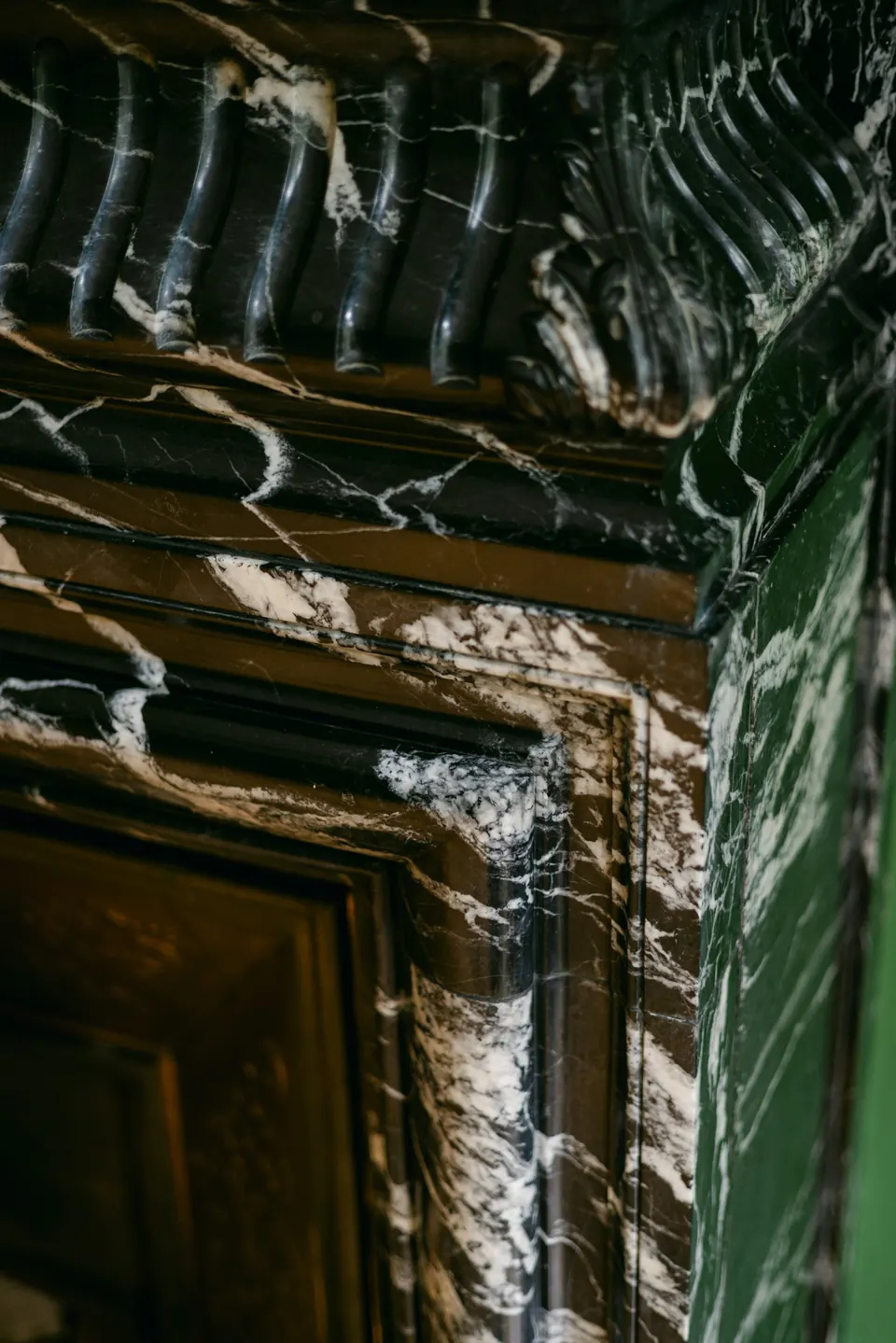
Salvage yards all over France sell them. It has to fit your opening, and the pieces should be numbered before it's taken down. Ask for the depth of each piece, old jambs are often thinner than they look. If a shelf is beyond repair we cut a new one in a matching stone. In 2023 our list had Black Marquina, Carrara White and black Portoro, and black marbles with gold or white veins are common on 19th-century surrounds. We hold the slab against the fireplace before deciding.
See marble fireplaces and the farmhouse guide.